The Final Mission of the Former USS Rodney M. Davis: How a Cold War Frigate Ended Its Service in a Naval Sinking Exercise
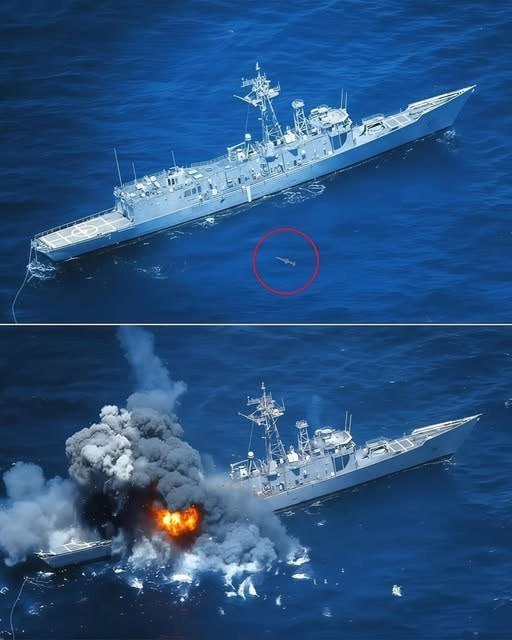
The former USS Rodney M. Davis (FFG-60), once a proud guided-missile frigate of the United States Navy, met its final fate not in combat but in a carefully planned naval exercise designed to improve future military readiness. After nearly four decades of service, the ship was deliberately sunk during a controlled SINKEX — a “sinking exercise” — when it was struck by a powerful anti-ship missile. While dramatic images of the strike circulated among defense observers, the event marked the vessel’s final mission as part of a long-standing training practice used by modern navies.
For many former sailors and naval historians, the sinking represented the end of a chapter in the long operational life of one of the Cold War’s most recognizable warship designs.
A Warship Built for the Cold War
The frigate was commissioned into the United States Navy in 1982 during a period of intense geopolitical competition between global superpowers. It belonged to the Oliver Hazard Perry-class, a series of guided-missile frigates built to protect larger naval formations and merchant shipping from submarine and air threats.
These ships were designed to perform multiple roles at sea. Their primary mission centered on anti-submarine warfare, but they were also equipped to conduct surface combat, escort operations, and maritime patrols. With their combination of radar systems, guided missiles, helicopters, and torpedoes, the Perry-class frigates became one of the most widely used warship designs in the U.S. Navy during the late twentieth century.
The vessel was named after Marine Sergeant Rodney Maxwell Davis, a Medal of Honor recipient who was killed in action during the Vietnam War. Naming the ship in his honor reflected a long naval tradition of commemorating acts of extraordinary bravery by American service members.
A Career Spanning Decades
Throughout its decades of service, the frigate participated in a wide range of operations around the world. Like many ships of its class, it operated across the Pacific and other strategic maritime regions, supporting joint exercises with allied navies and contributing to maritime security missions.
During its active years, the ship’s crew carried out patrols aimed at maintaining freedom of navigation, monitoring sea lanes, and supporting international cooperation at sea. Frigates like this one were particularly valuable because they were versatile platforms capable of responding quickly to different types of maritime threats.
Beyond operational deployments, the ship also played a role in training new generations of sailors. Thousands of service members served aboard the vessel over its lifetime, learning navigation, engineering, communications, and combat system operations.
For many veterans, their time aboard the ship represented an important chapter of their naval careers.
Retirement from Active Service
By the early twenty-first century, changes in naval technology and strategy gradually led to the retirement of many Oliver Hazard Perry-class frigates from U.S. service. Newer ships with advanced radar systems, improved missile defenses, and more modern combat capabilities began replacing them.
The USS Rodney M. Davis was eventually decommissioned after decades of active duty. Once removed from frontline service, older naval vessels are often repurposed in several ways. Some are transferred to allied nations, others are converted into museum ships, and some are used in live-fire training exercises.
In this case, the ship was selected for a SINKEX event — a naval exercise designed to test weapons and provide realistic training opportunities.
What Is a SINKEX?
A SINKEX, short for “sinking exercise,” is a controlled military training event in which decommissioned ships are intentionally sunk using live weapons. These exercises allow naval forces to test the performance of missiles, torpedoes, and other systems against real ship hulls.
While modern computer simulations provide valuable data, nothing fully replaces real-world testing against actual vessels. SINKEX events help engineers and military planners understand how weapons behave in real conditions, how ships respond to damage, and how future naval platforms can be designed to improve survivability.
Because of environmental concerns, strict procedures are followed before any ship is sunk. Hazardous materials such as fuels, oils, plastics, and electronic equipment must be removed beforehand to reduce the impact on the marine environment.
Preparing the Ship for Its Final Role
Before the former frigate was used in the exercise, extensive preparations were carried out. Teams worked to remove environmentally hazardous substances and classified systems that could not remain on the vessel.
This preparation process is essential to meet environmental protection regulations and ensure that the sinking does not harm marine ecosystems.
Once cleaned and cleared, the ship was towed to the designated exercise area. There it was positioned as a target for participating naval forces.
For many observers, seeing a once-active warship floating silently in the open ocean, awaiting its final mission, was a powerful reminder of the long history behind the vessel.
The Missile Strike
During the exercise, the ship was targeted with an AGM-84 Harpoon anti-ship missile. The Harpoon is one of the most widely used naval strike weapons in the world and has been deployed by numerous countries for decades.
Designed to fly at low altitude over the ocean surface, the missile can evade radar detection and strike enemy ships with significant explosive force. It is commonly used by aircraft, ships, and submarines to engage hostile vessels.
When the missile struck the retired frigate, it demonstrated the destructive capability of modern anti-ship weaponry. The controlled impact allowed analysts and military observers to gather detailed information about the weapon’s performance.
Such data is valuable for refining tactics, improving future weapons, and understanding how naval vessels respond to damage under real conditions.
A Moment of Reflection for Former Crews
Although the sinking was planned and conducted as part of a training exercise, it still carried emotional significance for many of the sailors who had once served aboard the ship.
Over the years, the frigate had been home to thousands of crew members who worked, trained, and lived together while deployed at sea. For them, the vessel was more than steel and machinery — it was part of their personal history.
When a ship that has served for decades is finally sunk during a SINKEX, veterans often reflect on the experiences they had aboard it and the friendships formed during long deployments.
Many former crew members see the ship’s final mission as a meaningful contribution to the future readiness of the navy.
Why Navies Use Retired Ships for Training
Using decommissioned ships as targets provides several important benefits for naval forces. First, it allows crews to train with live weapons under realistic conditions. Second, it offers engineers and analysts real-world data that cannot be fully replicated through computer modeling.
The information gathered from these exercises helps improve future warship designs, refine missile technology, and develop better strategies for naval combat.
In many cases, the lessons learned from a single SINKEX can influence naval planning for years.
The Legacy of the USS Rodney M. Davis
Although the ship no longer sails the world’s oceans, its legacy continues through the sailors who served aboard it and the role it played in decades of maritime operations.
From Cold War patrols to international exercises and maritime security missions, the frigate contributed to maintaining stability across critical sea routes.
Its final role in a naval exercise ensured that even in retirement, the ship continued to serve a purpose — helping the next generation of naval forces prepare for future challenges.
In this way, the vessel’s story reflects the broader life cycle of many warships: built for strategic competition, operated by generations of sailors, and ultimately used to advance the technologies and training that will shape tomorrow’s fleets.
Though the former USS Rodney M. Davis now rests beneath the ocean’s surface, its long service remains part of naval history — a reminder of the ships and crews that quietly support maritime security across the world.